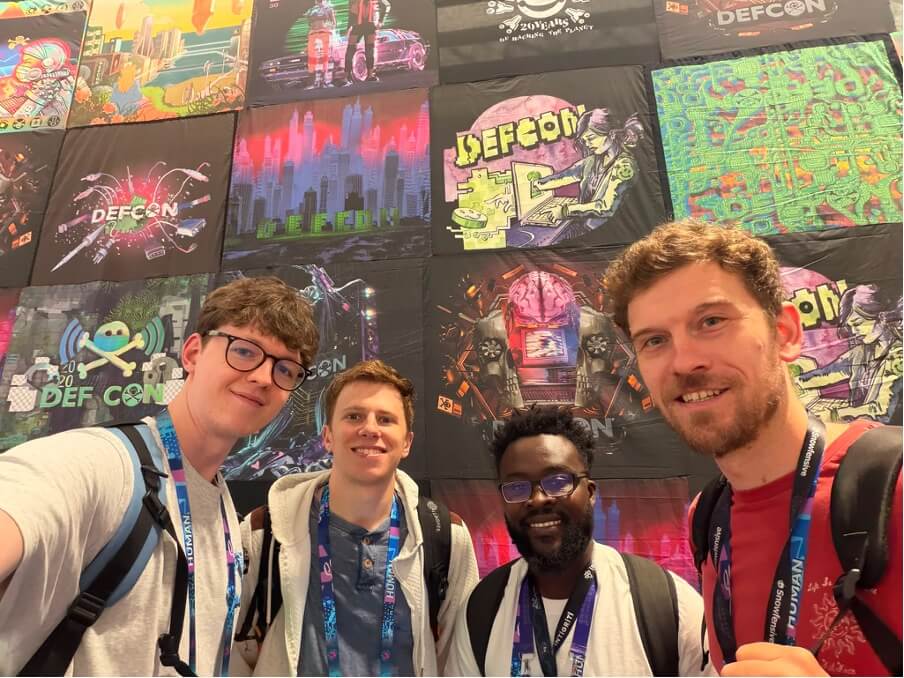

This year Predatech returned to Las Vegas for DEF CON 34. Joining tens of thousands of hackers, security researchers and other industry professionals, we spent the time networking, watching talks and exploring workshops.
As always, there was plenty to see and do, from practicing new red teaming techniques to hearing the latest developments in AI security and its growing role in offensive security. There were villages to suit everyone’s interests, even a Boat Hacking Village for those nautically minded hackers out there!
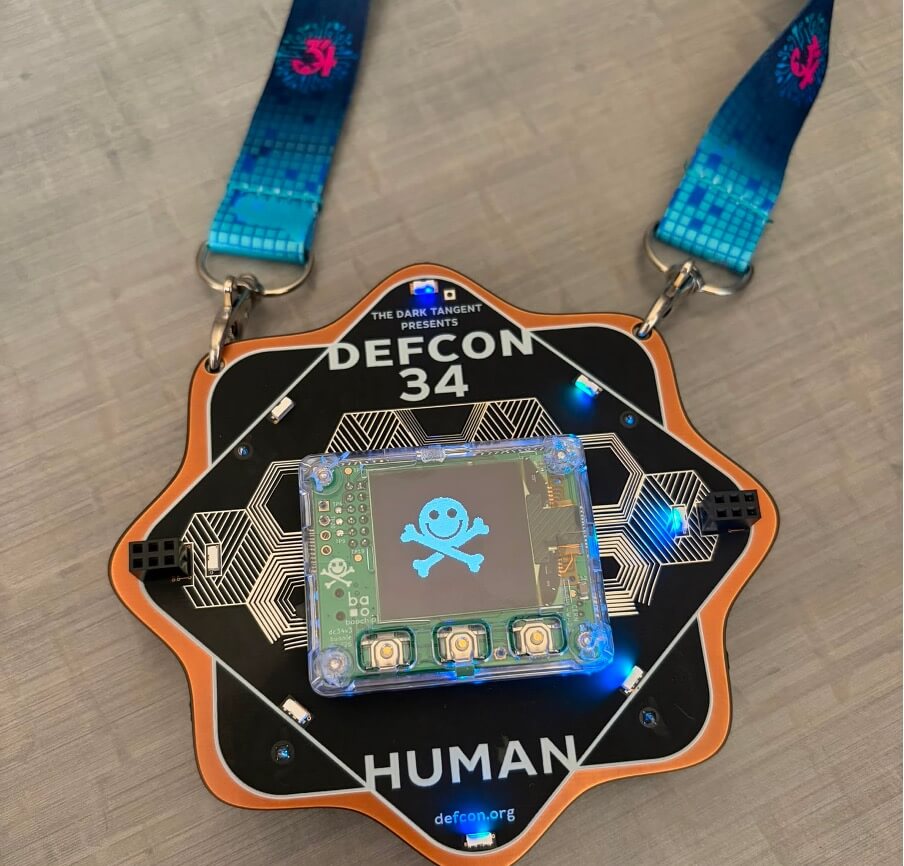
The DEF CON 34 Badge
This year, the DEF CON badge was designed by legendary hardware hacker Andrew “bunnie” Huang. At the heart of the badge was his new system-on-chip, the Baochip-1x, which was designed to be both literally and figuratively transparent, making it possible for users to inspect the hardware and better understand how it works.
The badge could be used to exchange light patterns with other conference attendees, adding a fun interactive element to what was already a very interesting piece of hardware. Perhaps the best part was that the badge wasn’t designed to become useless once DEF CON was over. It could be disassembled and repurposed as a TOTP authenticator, giving it a second life as a useful piece of hardware for further experimentation and research.
Lots of AI
As expected, AI was impossible to miss this year, but a couple of talks particularly stood out for us.
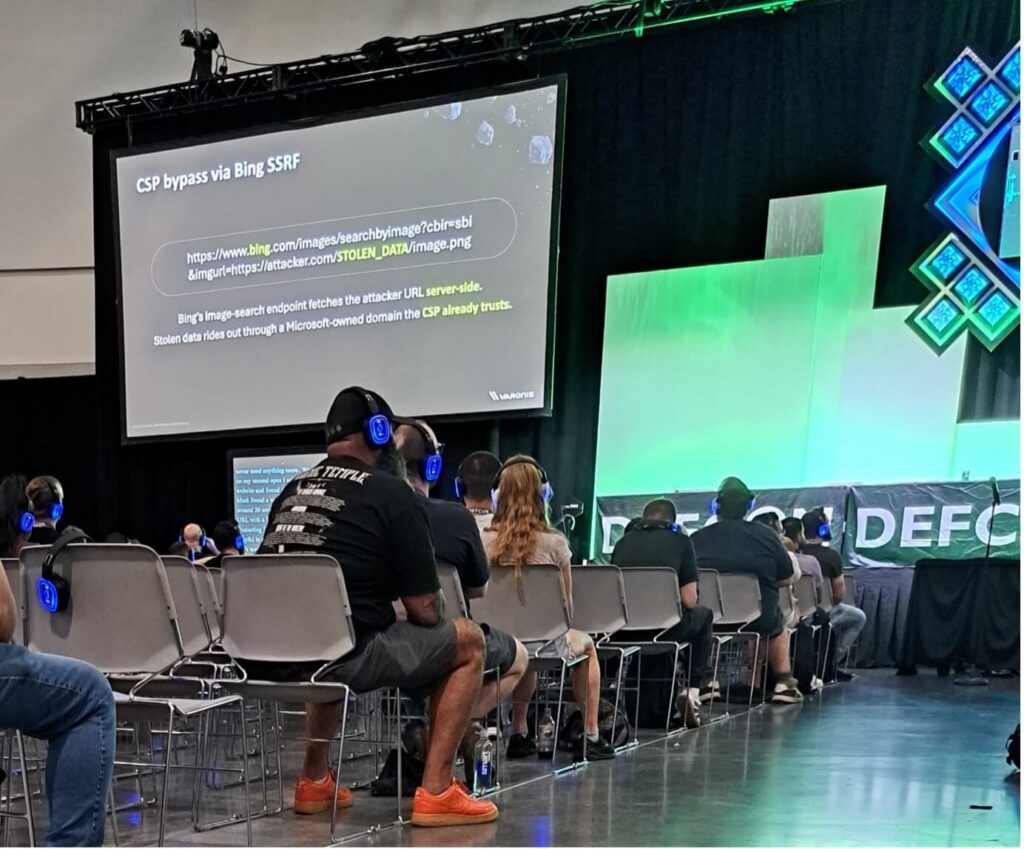
Elad Meged’s talk, The Sandbox Is a Suggestion: Deconstructing AI Agent Sandboxes, was a particularly interesting look at the security of AI coding agents. He shared the methodology used to identify vulnerabilities in the sandboxing and containment mechanisms of Anthropic’s Claude Code, Google’s Gemini CLI and OpenAI’s Codex CLI.
The methodology involved several stages: finding ways to inject into an AI agent session, identifying ways to bypass the agent’s security guardrails, and finally finding a way to exfiltrate data from the compromised environment.
It was a great example of how attacking AI agents isn’t necessarily about finding a single vulnerability. Instead, multiple weaknesses can be chained together to move from influencing the agent, to bypassing its restrictions and ultimately getting data out of the environment.
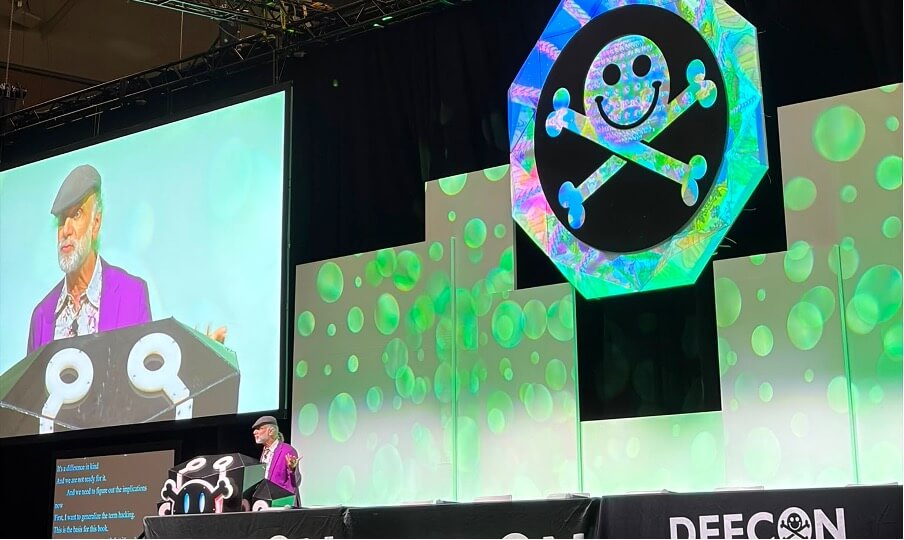
Bruce Schneier’s Hacking AI talk took a much higher-level view. Rather than focusing on how AI itself can be hacked, he explored how AI could be used to find “hacks” in everyday systems, such as tax systems, regulations and laws.
The interesting part was considering what happens when AI becomes capable of finding loopholes much faster than humans can. Laws and regulations are written with certain assumptions about how quickly people can analyse them and identify unintended consequences. If AI can search for these weaknesses at a much greater speed, society may struggle to update the rules quickly enough to keep up.
While Bruce’s talk was less directly applicable to the technical work we do, it was an interesting perspective on how the definition of “hacking” could expand well beyond computers.
Social Engineering Community Village
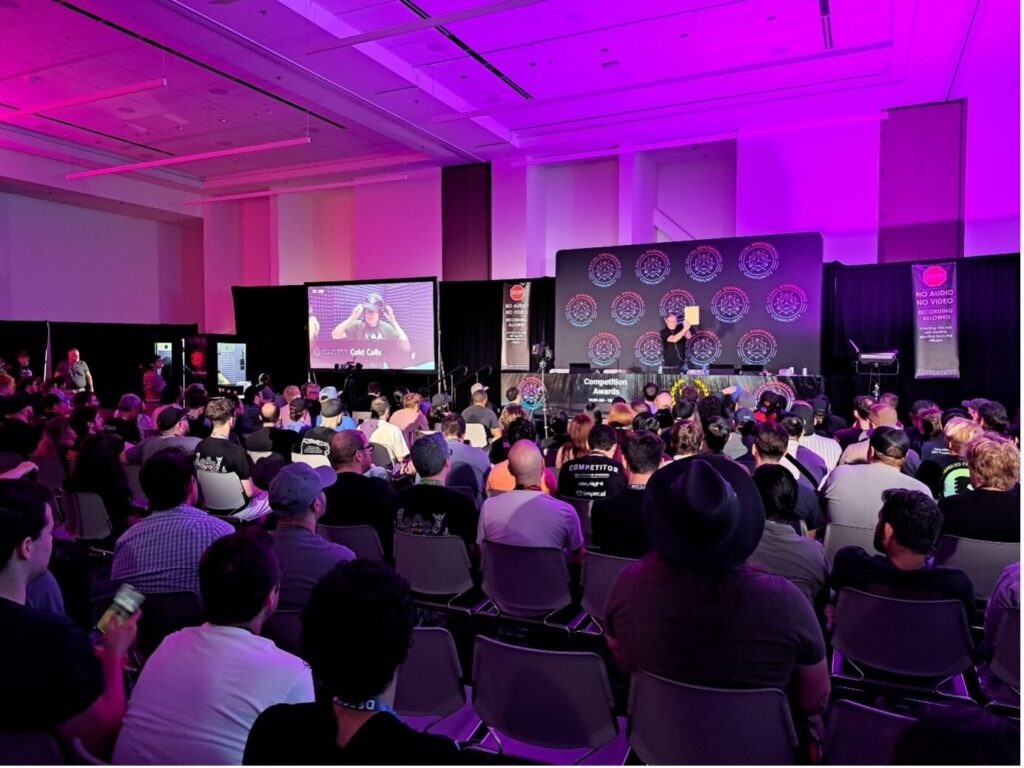
The Social Engineering Community Village was one of the our favourite stops. The CTF was both highly entertaining and educational, with the memes and commentary from the competition almost as entertaining as the social engineering itself.
AI even found its way into the village, with Battle of the Bots: Vishing Edition, where teams built AI-powered voice agents designed to make live vishing calls to real people.
Watching the bots attempt to socially engineer information was both impressive and a little scary. It was a good reminder that people remain an important part of an organisation’s security perimeter and perhaps one of the more unpredictable ones.
Bug Hunting at Bug Bounty Village
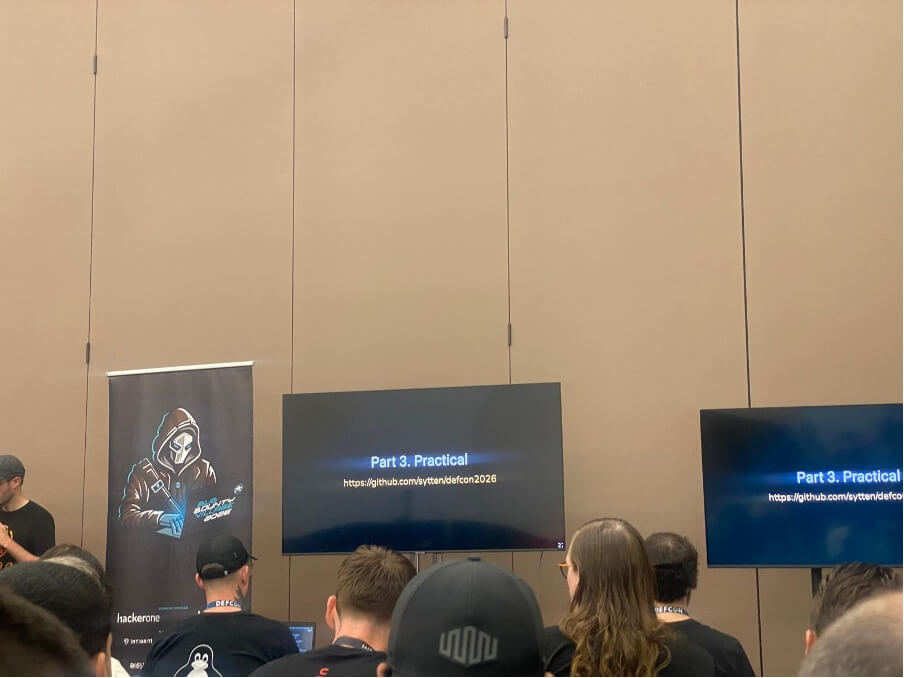
Bug Bounty Village offered another perspective on application security. The village featured technical talks, workshops and a CTF, with plenty of discussion around the techniques researchers use to find vulnerabilities that can be difficult to identify through conventional automated testing.
This was one of our consultant’s (Greg’s) favourite places to hang out. By the end of the conference, Greg seemed to know the whole village by name!
For the Predatech team, it was a good opportunity to see what techniques are currently being used by the wider research community and pick up ideas that could be applied to our own testing.
Taking DEF CON Back to Predatech
DEF CON is always a difficult event to summarise because there is simply too much happening at once. You can spend the morning learning about a new vulnerability, the afternoon picking locks and the evening discussing a completely different piece of research with someone you have just met.
This year, AI and its impact on offensive security were particularly difficult to ignore. The hackbot research was a standout for us, offering a glimpse into how AI agents could more effectively become another part of the penetration tester’s toolkit.
At the same time, the more traditional DEF CON experiences were still going strong. Red teaming, application security, bug hunting and social engineering all provided plenty of opportunities to learn, experiment and have some fun.
For the Predatech team, that combination is what makes DEF CON worth returning to year after year. We came away with new techniques to try, new ideas to explore and, of course, a rather good badge to add to the collection.
Until next time, DEF CON!